

Alcohol is one of the few substances that damages nearly every organ system in the body simultaneously. The harm does not announce itself early. For most people, it accumulates quietly for years before clinical symptoms surface, at which point significant structural damage has already occurred.
Understanding what chronic alcohol use does to the body, organ by organ, and what the research says about recovery helps clarify why professional treatment is not just about stopping drinking. It is about giving the body the conditions it needs to begin healing. If you are still assessing whether a drinking pattern has crossed into disorder territory, signs of alcoholism and signs of high-functioning alcoholism are worth reviewing alongside the physical picture described here.
What Alcohol Does to the Liver, and What the Research Shows
The liver metabolizes approximately 90 percent of ingested alcohol, making it the organ most directly exposed to alcohol’s toxic byproducts. The National Institute on Alcohol Abuse and Alcoholism identifies three progressive stages of alcohol-related liver disease: fatty liver, alcoholic hepatitis, and cirrhosis.
Fatty liver, the earliest stage, develops in up to 90 percent of people who drink heavily. Fat accumulates in liver cells, impairing function. This stage is largely reversible. Abstinence from alcohol for several weeks to months allows the liver to clear excess fat and restore normal function in most cases.
Alcoholic hepatitis, the middle stage, involves inflammation and cell death. A 2020 review published in Nature Reviews Gastroenterology and Hepatology found that moderate-to-severe alcoholic hepatitis carries a 30-day mortality rate of up to 50 percent in the most severe presentations. Abstinence at this stage can still produce meaningful recovery, though some functional deficits may persist.
Cirrhosis represents irreversible scarring of liver tissue. Once cirrhosis develops, the damaged architecture cannot be restored. What abstinence does at this stage is slow further progression, reduce complications such as bleeding and infection, and in some patients, stabilize enough to eventually qualify for liver transplantation.
The Brain Under Chronic Alcohol Exposure
Alcohol crosses the blood-brain barrier and disrupts the balance between excitatory and inhibitory neurotransmitters. Over time, this disruption causes structural and functional changes that extend well beyond the acute effects of intoxication. The distinction between heavy drinking and clinical alcohol use disorder matters here, because the brain changes associated with AUD are more severe and more persistent than those linked to episodic heavy drinking. That difference is explained in more detail in heavy drinking vs. alcohol use disorder.
Neuroimaging studies from the NIAAA document consistent reductions in gray matter volume and white matter integrity in people with alcohol use disorder, or AUD. Regions most affected include the prefrontal cortex, which governs decision-making and impulse control, and the hippocampus, which consolidates memory. The damage correlates directly with the duration and quantity of alcohol exposure.
Wernicke-Korsakoff syndrome, a neurological disorder caused by thiamine deficiency linked to heavy alcohol use, produces severe memory impairment, confusion, and in advanced cases, permanent cognitive disability. The National Institute of Neurological Disorders and Stroke notes that prompt thiamine supplementation can reverse the acute phase, but delayed treatment often results in irreversible memory loss.
Brain recovery after stopping alcohol is well-documented and depends heavily on age at onset of heavy drinking, duration of use, and overall health. White matter integrity shows meaningful recovery within the first year of abstinence in many patients. Gray matter volume improvements are slower and less complete, particularly in individuals who began drinking heavily in adolescence. Neuroinflammation, an immune response triggered by chronic alcohol exposure in the brain, also plays a role in cognitive impairment and is explored further in neuroinflammation and addiction.
What the Brain Can and Cannot Recover From
The distinction between reversible and permanent neurological damage shapes what patients and families should realistically expect from sobriety:
What typically recovers:
- White matter connectivity, often showing improvement within 6 to 12 months of abstinence
- Sleep architecture, which normalizes significantly within 1 to 2 years
- Verbal memory and processing speed, with gradual improvement over months
- Emotional regulation, as dopamine and serotonin systems recalibrate
What recovers more slowly or incompletely:
- Frontal lobe function in people with 20 or more years of heavy use
- Spatial processing and fine motor coordination in older patients
- Memory consolidation in individuals with Wernicke-Korsakoff syndrome
- Cognitive flexibility in those with co-occurring mental health conditions
How Alcohol Damages the Heart, Pancreas, and Immune System
The physical effects of alcoholism extend beyond the liver and brain to affect the cardiovascular system, pancreas, and the body’s immune defenses.
Cardiovascular effects: Chronic heavy drinking raises blood pressure, weakens heart muscle, and increases the risk of arrhythmias. Alcoholic cardiomyopathy, a condition in which the heart muscle thins and loses pumping efficiency, develops in a subset of people with long-term heavy use. Research published in the Journal of the American College of Cardiology found that abstinence in the early stages of alcoholic cardiomyopathy can produce substantial improvement in cardiac function, with some patients showing near-complete recovery of ejection fraction within 12 to 18 months.
Pancreatic effects: Alcohol triggers premature activation of digestive enzymes within the pancreas, causing the organ to begin digesting itself. Acute pancreatitis can be life-threatening. Chronic pancreatitis, marked by progressive destruction of pancreatic tissue, leads to malnutrition, chronic pain, and in advanced cases, diabetes. Unlike liver fibrosis, pancreatic damage does not reverse after abstinence, though stopping alcohol significantly slows further progression.
Immune function: Alcohol impairs the production and activity of white blood cells, reduces the effectiveness of mucosal barriers in the respiratory tract, and disrupts the gut microbiome in ways that allow bacterial products to enter systemic circulation. The NIAAA notes that people with AUD are significantly more susceptible to bacterial pneumonia, tuberculosis, and post-surgical infections. Immune recovery begins within weeks of abstinence and continues over months as gut flora rebalance.
Physical Signs That Warrant Medical Evaluation
The following symptoms in the context of heavy alcohol use indicate organ involvement that requires clinical assessment rather than monitoring:
- Jaundice (yellowing of the skin or whites of the eyes)
- Ascites (abdominal swelling due to fluid accumulation)
- Peripheral edema (swelling in the legs and ankles)
- Unexplained bruising or prolonged bleeding
- Persistent nausea, vomiting, or upper abdominal pain
- Confusion, memory gaps, or difficulty concentrating that persists after drinking stops
- Heart palpitations or shortness of breath at rest
- Tremors that appear when alcohol wears off
Several of these symptoms indicate conditions that can become medically dangerous without supervision. Alcohol withdrawal itself can produce seizures and delirium tremens, which is why medically supervised detox is the appropriate first step rather than attempting to stop without clinical support.
What Sobriety Does to the Body, and How Long It Takes
The body’s capacity for recovery after stopping alcohol is substantial, but the timeline varies by organ, by the duration and severity of prior use, and by the individual’s age and overall health.
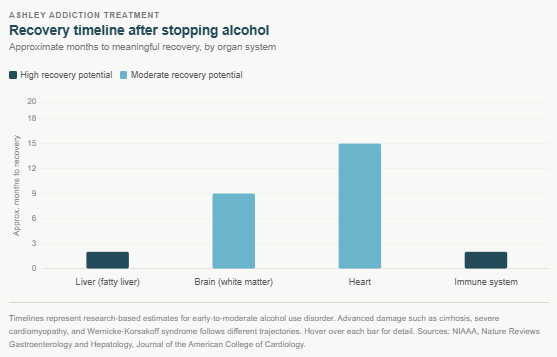
The first 30 days of abstinence produce the most dramatic changes. Blood pressure begins to drop within days. Sleep quality improves as the brain exits chronic alcohol suppression. Liver enzymes, which elevate with ongoing alcohol exposure, begin to normalize within two to four weeks in patients without advanced disease. Skin hydration and color improve as the body rehydrates and liver function stabilizes.
Between one and six months, cognitive function improves measurably in most patients. Processing speed, attention, and working memory show consistent improvement in studies of early recovery. The NIAAA’s research on recovery timelines documents that many structural brain changes begin to reverse within this window, with continued improvement extending into the second and third year. A detailed look at the mechanisms behind this process is available in how the brain heals after substance use.
Beyond six months, recovery becomes less linear. Patients with significant liver disease, advanced cardiovascular damage, or long-standing cognitive impairment face a different trajectory than those who stopped earlier. But across populations, the research consistently shows that the benefits of abstinence accumulate over time and that later recovery still produces meaningful gains.
Finding an Alcohol Treatment Center Near You
Stopping alcohol after years of heavy use is not something the body handles safely on its own. The physical effects of alcoholism include withdrawal syndromes that require medical management, and the psychological dimension of recovery is rarely addressed by willpower alone.
Alcohol rehab facilities in Maryland vary in scope and clinical depth. Alcoholism treatment facilities that offer a full continuum of care, from medically supervised detox through inpatient programming and structured aftercare, produce better long-term outcomes than those addressing only one phase of treatment.
Ashley Addiction Treatment operates its main campus in Havre de Grace, Maryland, with inpatient programs and outpatient services. The clinical team includes board-certified physicians, psychiatrists, and licensed addiction counselors who build individualized treatment plans around the full picture of a patient’s health, not just their substance use.
If you are looking for a rehab center for alcohol or trying to understand what the right level of care looks like, the admissions team at Ashley Addiction Treatment can help you work through those questions before any decision is made. Reach out through the admissions inquiry form or the contact page to start that conversation.